
How Computer Vision Automates Quality Control on Production Lines
How Computer Vision Automates Quality Control on Production Lines
Table of Contents
- Key Takeaways
- The Quality Problem That Won't Solve Itself
- What Is Computer Vision Quality Control?
- How Computer Vision Works on a Production Line
- Real-World Applications Across Industries
- The Business Case: ROI of Automated Inspection
- How to Implement Computer Vision QC
- Challenges and How to Overcome Them
- Future Trends in AI Quality Control
- FAQ
- Conclusion
Key Takeaways
Key Takeaways:
- Computer vision QC systems can achieve defect detection rates above 99.5%, far surpassing manual inspection accuracy of roughly 80-90%.
- The global computer vision market in manufacturing is projected to exceed USD 25 billion by 2030, driven by demand for automated quality control and Industry 4.0 adoption.
- Manufacturers implementing AI quality control typically see a 30-50% reduction in defect-related costs within the first 12-18 months.
- Modern systems integrate seamlessly with existing production lines using standard industrial cameras and edge computing hardware.
- The payback period for a well-scoped computer vision QC system generally falls between 6 and 18 months.
The Quality Problem That Won't Solve Itself
Every manufacturing operation shares one constant pressure: deliver consistent quality at scale. As product complexity increases and customer expectations rise, the margin for error shrinks. A single defective batch can mean lost contracts, expensive recalls, or — worse — brand damage that takes years to repair.
Traditional quality control relies heavily on human inspectors. And while skilled inspectors bring invaluable experience, they face physiological limitations that no amount of training can overcome. Fatigue sets in after a few hours of repetitive inspection. Attention drifts. Consistency varies between shifts, between operators, between Monday morning and Friday afternoon.
Consider the math: an inspector examining 60 parts per minute for an eight-hour shift evaluates nearly 29,000 items per day. Even a 1% miss rate means close to 290 defective parts slip through — every single day. Across multiple production lines and facilities, the numbers compound rapidly.
This isn't a new problem. But the solution landscape has shifted dramatically in recent years. Computer vision — powered by deep learning and advances in processing hardware — has moved from laboratory curiosity to production-ready technology that's accessible to manufacturers of all sizes.
What Is Computer Vision Quality Control?
Computer vision quality control uses cameras, lighting systems, and AI algorithms to automatically inspect products on a production line. Unlike fixed-rule machine vision systems that check for specific, predefined patterns, modern computer vision systems learn from examples. They can identify subtle defects, surface anomalies, dimensional variations, and assembly errors that would be difficult or impossible to program with traditional rules.
At its core, a computer vision QC system performs the same task a human inspector does — it looks at a product and decides whether it meets quality standards. But it does this with superhuman speed, consistency, and reliability.
The key distinction: traditional machine vision vs. AI-powered computer vision
Traditional machine vision systems have been used in manufacturing for decades. They excel at precise measurements — checking whether a hole is exactly 5mm in diameter, verifying that a label is positioned within a 1mm tolerance, or counting items on a conveyor. These systems use rule-based algorithms: if pixel contrast at position X exceeds threshold Y, flag the part.
AI-powered computer vision, by contrast, learns what "good" and "bad" look like from training data. It can handle variation that would break a rules-based system — different lighting conditions, slight changes in product finish, acceptable natural variation versus genuine defects. This makes it far more flexible and easier to deploy for complex inspection tasks.
How Computer Vision Works on a Production Line
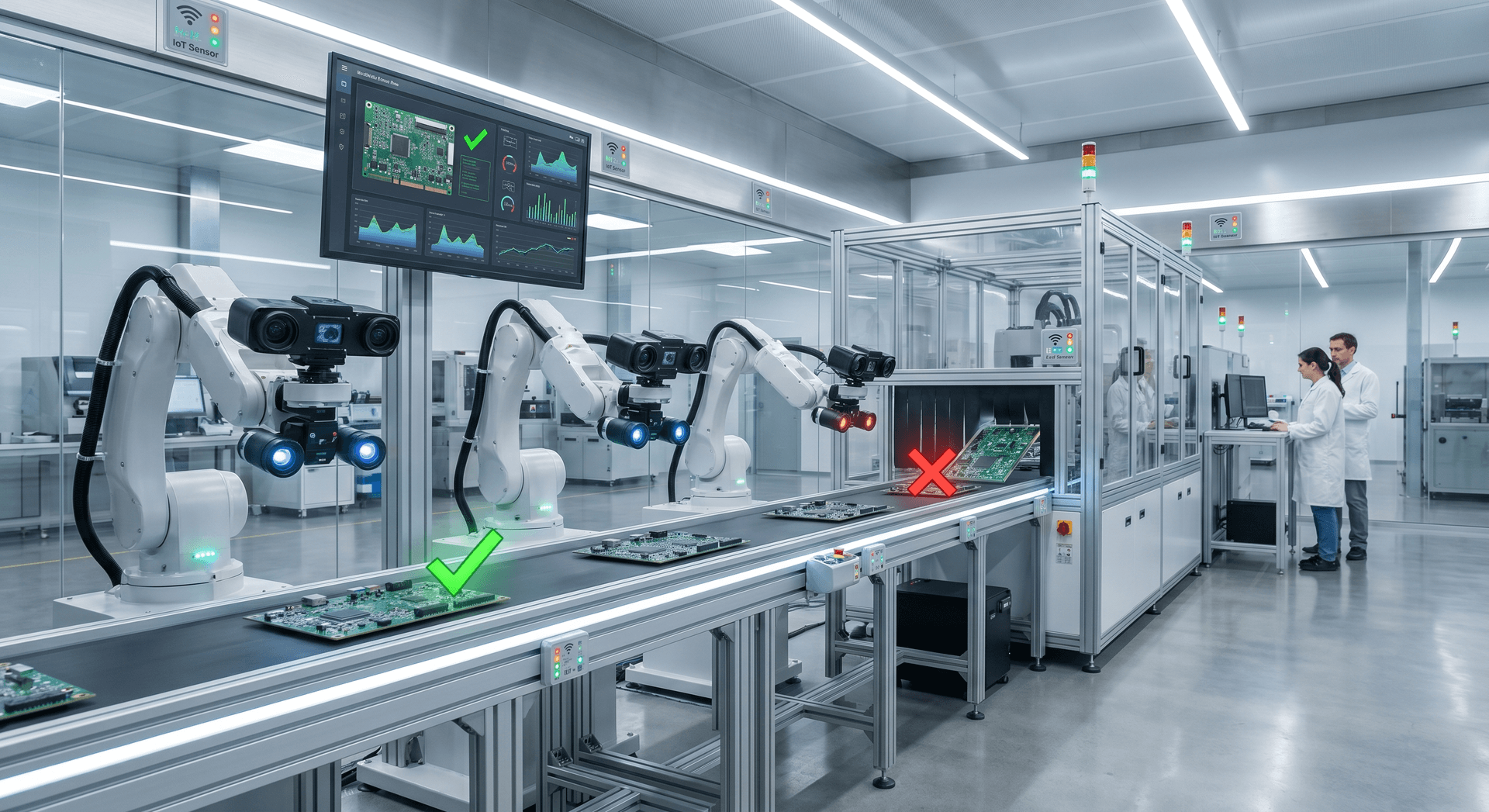
Understanding the architecture helps demystify the technology. A typical production-line computer vision QC system has four main components:
1. Image Acquisition
It starts with capturing a clear, consistent image of each product as it passes the inspection point. This involves:
- Industrial cameras — typically line-scan or area-scan cameras positioned above or beside the production line. Modern systems often use GigE Vision or USB3 Vision cameras, which offer excellent image quality at reasonable cost.
- Lighting — arguably the most critical and often underestimated component. Proper lighting (LED bar lights, dome lights, backlights, or structured light) ensures defects are visible and consistent regardless of ambient conditions.
- Triggering mechanisms — sensors or encoders detect when a product reaches the inspection point and trigger image capture.
2. Image Preprocessing
Raw images rarely go straight to the AI model. Preprocessing steps may include noise reduction, contrast enhancement, image alignment, and region-of-interest extraction. These steps ensure the AI model receives clean, consistent input.
3. AI-Based Analysis
The preprocessed image feeds into a trained neural network that classifies the product. Modern systems typically use convolutional neural networks (CNNs) or, increasingly, vision transformers. The model has been trained on thousands of labeled images — some showing acceptable products, others showing various types of defects.
The output is typically one of three decisions:
- Pass — product meets quality standards
- Fail — specific defect identified (scratch, dent, missing component, incorrect assembly, etc.)
- Review — borderline case flagged for human inspection (most systems include this "grey area" to handle ambiguous situations)
4. Actuation and Feedback
When a defect is detected, the system triggers a physical response — a pneumatic reject arm pushes the defective item off the line, a gate diverts it to a reject bin, or a visual/audible alert signals an operator. Simultaneously, the system logs every inspection result, building a database that feeds continuous improvement.
Most modern systems operate at the edge — processing happens on an industrial PC or dedicated inference hardware (like NVIDIA Jetson or Intel-based edge devices) right on the factory floor, enabling real-time decisions with minimal latency.
Real-World Applications Across Industries
Computer vision QC isn't limited to one sector. Here's how different industries are applying it:
Electronics Manufacturing
Printed circuit board (PCB) inspection was one of the earliest and most successful applications. Automated optical inspection (AOI) systems check solder joints, component placement, trace continuity, and pad quality at speeds of several boards per second. Modern AI-enhanced AOI can detect defects as small as 10 micrometers — roughly the diameter of a human red blood cell.
Beyond PCBs, computer vision inspects connector assemblies, display panels for dead pixels, and smartphone housings for cosmetic defects. Given the zero-tolerance nature of electronics quality, the business case is straightforward.
Automotive
The automotive industry uses computer vision throughout the manufacturing process. Paint inspection systems detect scratches, orange peel texture, and color inconsistencies on vehicle bodies. Assembly verification systems check that all components — bolts, clips, seals — are present and correctly positioned before a vehicle moves to the next station. Tire inspection systems look for bulges, embedded debris, and tread pattern irregularities.
Food and Beverage
Contaminant detection is critical — metal fragments, glass shards, or plastic pieces in food products pose serious safety risks. Computer vision systems inspect products on high-speed lines, identifying foreign objects, verifying fill levels, checking seal integrity, and ensuring labeling accuracy. Unlike X-ray systems, visual inspection is non-destructive and can detect surface-level contaminants and packaging defects that X-rays miss.
Pharmaceuticals
Pharmaceutical manufacturing demands rigorous quality control. Computer vision verifies tablet/capsule appearance, checks blister pack completeness, inspects label accuracy and legibility, and monitors fill levels in liquid medications. Given regulatory requirements (FDA 21 CFR Part 11, EU GMP), the audit trail that computer vision systems provide is itself a significant benefit.
Textiles and Apparel
Fabric inspection systems scan for weaving defects, color inconsistencies, stains, and pattern misalignment. In apparel manufacturing, computer vision checks seam quality, button placement, and overall garment assembly.
The Business Case: ROI of Automated Inspection
The financial case for computer vision QC rests on both cost reduction and revenue protection. Here's a framework for evaluating it:
Direct Cost Savings
Reduced scrap and rework. Catching defects early — ideally at the point of origin — prevents defective parts from moving downstream where they become more expensive to fix. A defect caught at the stamping station costs pennies to correct. The same defect discovered at final assembly might cost dollars. Discovered by the customer, it can cost hundreds in warranty claims, returns, and lost future business.
Lower labour costs. A single computer vision system can replace multiple inspection stations. This doesn't necessarily mean headcount reduction — skilled inspectors can be redeployed to higher-value activities like process improvement, root cause analysis, and system management.
Reduced warranty and recall costs. Defective products that reach customers generate warranty claims, product returns, and potentially expensive recalls. The average cost of a product recall in manufacturing exceeds USD 10 million when accounting for logistics, replacement, brand damage, and regulatory penalties.
Revenue Protection
Consistent quality drives customer retention. In B2B manufacturing, quality consistency is often the primary factor in contract renewal. Computer vision QC provides the statistical evidence that quality standards are being met — every part, every shift, every day.
Market access. Some markets and customers require documented quality processes. Computer vision systems with comprehensive logging capabilities provide the data trail needed to meet these requirements and win new contracts.
Typical ROI Metrics
While every deployment is unique, here are representative benchmarks from manufacturing implementations:
| Metric | Typical Range |
| Defect detection accuracy | 99.5% - 99.9% |
| Inspection speed | 1 - 60+ parts per second (application-dependent) |
| False positive rate | < 1% after tuning |
| Cost per inspection | USD 0.001 - 0.01 per part |
| Payback period | 6 - 18 months |
| Annual defect cost reduction | 30% - 50% |
How to Implement Computer Vision QC
A successful implementation follows a structured approach:
Step 1: Define the Problem Clearly
Not every quality problem needs computer vision. Start by answering:
- What specific defects are you trying to detect?
- What's the current defect rate and cost?
- What's the required inspection speed (parts per minute)?
- What are your tolerance criteria — what's "good enough" vs. "defective"?
Step 2: Assess Feasibility
Some defects are inherently easier to detect visually than others. Surface defects (scratches, dents, discoloration) are generally well-suited. Internal defects require other methods (X-ray, ultrasonic). Work with an experienced solutions provider to assess whether your specific inspection task is viable for computer vision.
Step 3: Collect Training Data
The AI model needs examples. Plan to collect several hundred to several thousand images of:
- Normal, acceptable products (showing natural variation)
- Products with each type of defect you want to detect
- Edge cases and ambiguous samples
Data quality directly determines system performance. Invest time in proper data collection — it pays dividends throughout the system's life.
Step 4: Proof of Concept
Before committing to a full deployment, run a proof of concept (PoC) on a single production line. This typically takes 4-8 weeks and provides:
- Validation that the technology can detect your specific defects
- Performance benchmarks (accuracy, speed, false positive rate)
- Integration learnings (camera positioning, lighting, communication with line controls)
- A realistic cost estimate for full deployment
Step 5: Scale and Integrate
Based on PoC results, plan the full rollout. Key considerations:
- How many inspection points are needed?
- What's the infrastructure requirement (power, network, mounting)?
- How does the system integrate with existing SCADA/MES systems?
- What training do operators need?
- What's the maintenance and support plan?
Step 6: Continuous Improvement
Computer vision systems improve over time. As new defect types emerge or products change, the model can be retrained with additional data. The inspection database becomes a valuable quality analytics resource, enabling trend analysis and predictive quality insights.
Challenges and How to Overcome Them
"We don't have enough defective samples for training"
This is one of the most common concerns — and a valid one. In well-controlled processes, defects may be rare, making it difficult to collect enough examples.
Solutions:
- Use data augmentation techniques to artificially expand your defect dataset
- Leverage anomaly detection approaches that learn from "normal" samples only
- Work with synthetic data generation tools that create realistic defect images
- Start with the defects you can collect and expand the model over time
"Our products vary too much"
Natural product variation — slight color shifts between batches, acceptable surface texture differences — can cause false positives if the model isn't properly trained.
Solutions:
- Ensure training data covers the full range of acceptable variation
- Use hierarchical classification: first determine product variant, then apply variant-specific inspection criteria
- Implement dynamic thresholding that adapts to current production conditions
"The lighting conditions on our floor change throughout the day"
Inconsistent lighting is the enemy of reliable visual inspection.
Solutions:
- Invest in controlled lighting systems (LED, wavelength-specific)
- Enclose the inspection area to block ambient light
- Use lighting-independent features in the AI model (modern architectures are surprisingly robust to moderate lighting variation)
- Implement automatic gain and exposure control
"Our operators don't trust the system"
Resistance to automation is natural, especially from experienced inspectors who take pride in their work.
Solutions:
- Involve operators early in the process — their domain knowledge is invaluable for data labelling and edge case identification
- Position the system as a tool that assists inspectors rather than replaces them
- Start with a "shadow mode" where the system runs alongside human inspection, building trust through demonstrated performance
- Provide clear dashboards showing system accuracy and improvement over time
"We're worried about the total cost"
Computer vision systems require upfront investment in hardware, software, and integration services.
Solutions:
- Start small with a high-impact, well-defined inspection task
- Consider cloud-based or subscription models that reduce initial capital expenditure
- Focus on the total cost of quality — not just the system cost, but the current cost of defects, inspection labour, scrap, and warranty claims
- Look for solutions providers who offer flexible deployment models and proven ROI in your industry
Future Trends in AI Quality Control
The technology is evolving rapidly. Here are the developments reshaping computer vision QC:
Vision-Language Models
Large vision-language models (VLMs) are beginning to enable natural-language defect descriptions. Instead of binary pass/fail, future systems may provide rich, contextual output: "Minor surface scratch on the top-right quadrant, approximately 3mm in length — within acceptable tolerance for Grade B output." This makes AI inspection more transparent and easier to trust.
Multimodal Inspection
Combining visual inspection with other sensor data — thermal imaging, acoustic sensors, vibration analysis — provides a more complete quality picture. A product might look perfect visually but have an internal delamination detectable only through thermal or acoustic analysis.
Self-Supervised Learning
Models that learn from unlabeled data are reducing the dependency on extensive labelled datasets. This is particularly valuable for new product lines where defect examples haven't accumulated yet.
Digital Twin Integration
Computer vision inspection data feeds into digital twins of production processes, enabling predictive quality — anticipating defects before they occur based on subtle process drift patterns detected in inspection data.
Edge AI Advances
Continued improvements in edge computing hardware mean more processing power at lower cost and power consumption. This enables higher-resolution inspection at faster line speeds, with more complex models running in real-time at the edge.
FAQ
Q: How accurate is computer vision compared to human inspectors? A: Well-implemented computer vision systems achieve 99.5-99.9% detection accuracy, compared to approximately 80-90% for human inspectors under realistic production conditions. The gap widens significantly as inspection rates increase — humans fatigue, machines don't.
Q: How long does it take to deploy a computer vision QC system? A: A proof of concept typically takes 4-8 weeks. Full production deployment ranges from 2-6 months depending on complexity, integration requirements, and the number of inspection points. Simpler, well-defined tasks can be faster.
Q: Can computer vision work with reflective or shiny surfaces? A: Yes, with proper lighting design. Polarised lighting, dome illumination, and structured light techniques can handle challenging surface conditions. This is one area where experienced system integrators add significant value.
Q: What happens when we introduce a new product variant? A: The system needs to be updated — typically by adding training data for the new variant and retraining or fine-tuning the model. Modern platforms make this process straightforward, often achievable in days rather than weeks. Some systems support transfer learning, where knowledge from existing products accelerates learning for new ones.
Q: Is computer vision QC suitable for small-batch or high-mix manufacturing? A: It can be, but requires the right approach. Traditional systems struggle with high product variety, but modern AI-based systems with flexible classification and quick-changeover capabilities are increasingly viable. The key is designing the system architecture for flexibility from the outset.
Q: How much does a typical computer vision QC system cost? A: Costs vary widely based on complexity. A single inspection point with standard hardware typically ranges from USD 15,000 to 60,000 for hardware and software, plus integration services. More complex multi-camera setups or high-speed applications can exceed USD 100,000. Against defect costs that often run into millions annually, the investment is usually justified within the first year.
Conclusion
Computer vision has crossed the threshold from emerging technology to proven production tool. For manufacturers in Hong Kong and across the Greater Bay Area — where competitive pressure demands continuous quality improvement and cost optimisation — automated inspection isn't a future consideration. It's a present-day competitive advantage.
The question is no longer whether computer vision can handle your quality control challenges. For most surface-level and assembly verification tasks, the answer is clearly yes. The real question is: which inspection problem should you solve first, and how quickly can you deploy?
At IoTree, we help manufacturers across Hong Kong identify their highest-impact quality control opportunities and implement computer vision solutions that deliver measurable ROI. From initial assessment through deployment and ongoing optimisation, our team brings deep expertise in both AI technology and manufacturing processes.
If you're ready to explore how computer vision can transform your production line quality control, we'd like to hear from you. Visit blog.iotree.hk to learn more about our AI and IoT solutions, or get in touch to discuss your specific inspection challenges.
#AISolutions #IoT #SmartBusiness #DigitalTransformation