
AI in Retail and E-commerce: Transforming Shopping Experiences and Business Operations in 2026
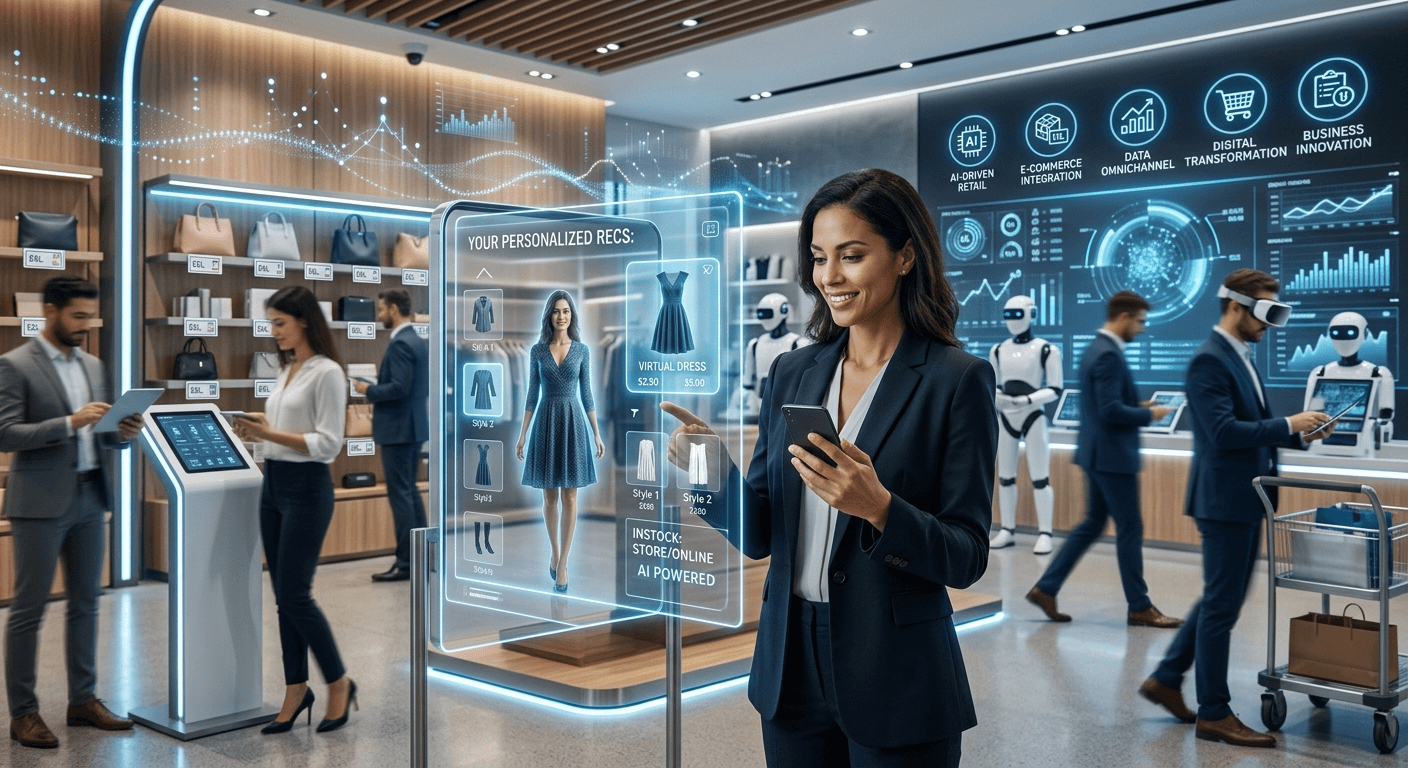
AI in Retail and E-commerce: Transforming Shopping Experiences and Business Operations in 2026
Direct Answer
Artificial Intelligence is revolutionizing retail and e-commerce by creating personalized shopping experiences, optimizing operations, and driving unprecedented growth. In 2026, AI-powered retail technologies are helping businesses increase sales by 25-40%, reduce operational costs by 20-35%, and improve customer satisfaction scores by up to 45%. The global AI in retail market is projected to reach $45.8 billion by 2027, growing at 35.4% annually, making AI adoption essential for competitive advantage in today's digital marketplace.
Key Takeaways
- Personalization Power: AI recommendation engines drive 35% of all e-commerce sales and increase conversion rates by up to 40%
- Operational Efficiency: AI-powered inventory management reduces stockouts by 16% and cuts carrying costs by 30%
- Customer Experience: Chatbots handle 80% of customer inquiries while reducing response times by 85%
- Market Growth: The AI in retail market will reach $45.8 billion by 2027 with 35.4% CAGR
- Cost Savings: Retailers using AI for operations report 25-35% cost savings in key areas
- Competitive Edge: 85% of retail executives believe AI is crucial for their competitive advantage within two years
Top 20+ AI in Retail Statistics with Sources
- Market Size: The global AI in retail market is projected to reach $45.8 billion by 2027 (MarketsandMarkets)
- Growth Rate: 35.4% compound annual growth rate for AI in retail (Grand View Research)
- Sales Impact: AI recommendation engines drive 35% of all Amazon sales (McKinsey)
- Customer Satisfaction: AI implementations improve customer satisfaction scores by 45% (Adobe)
- Operational Costs: AI reduces retail operational costs by 25-35% (Deloitte)
- Inventory Optimization: AI-powered inventory management reduces stockouts by 16% (Walmart)
- Cost Reduction: Inventory carrying costs reduced by 30% through AI (IBM)
- Chatbot Effectiveness: AI chatbots handle 80% of customer inquiries (Chatbots Magazine)
- Response Times: Chatbots reduce response times by 85% compared to human agents (IBM)
- Personalization Impact: Personalized experiences increase conversion rates by 40% (Epsilon)
- Market Adoption: 85% of retail executives say AI is crucial for competitive advantage (PwC)
- Implementation Costs: Average AI implementation cost for mid-sized retailer: $2-5 million (Gartner)
- Staffing Savings: Walmart saved $1 billion annually through AI-powered staffing (Forbes)
- Return on Investment: AI projects in retail typically achieve 15-25% ROI (BCG)
- Fraud Reduction: AI reduces fraudulent transactions by 60% (Financial Times)
- Sales Increase: Smart stores report 7% higher sales (NRF)
- Efficiency Gains: AI automation reduces checkout times by 60% (Amazon)
- Data Processing: AI systems analyze customer data 10x faster than humans (Salesforce)
- Voice Commerce: 40% of online interactions will be through voice by 2025 (Gartner)
- Sustainability Impact: AI reduces food waste by 30-40% in retail (UNEP)
- Staff Productivity: AI improves staff productivity by 35% (McKinsey)
- Personalized Marketing: AI-powered email campaigns achieve 3x higher engagement rates (Mailchimp)
Frequently Asked Questions
Q1: How much does AI implementation cost for retailers?
A1: Implementation costs vary widely, but mid-sized retailers typically spend $2-5 million on initial AI implementation, with ongoing maintenance costs. However, most retailers achieve 15-25% ROI within 12-18 months, making the investment worthwhile.
Q2: What are the biggest challenges in implementing AI in retail?
A2: Key challenges include high implementation costs, integration with legacy systems, data privacy concerns, talent shortages, and managing change within the organization. Many retailers overcome these by starting with pilot programs and scaling gradually.
Q3: How quickly can retailers expect to see results from AI implementation?
A3: Quick wins like chatbots and basic recommendation systems can show results in 3-6 months, while more complex implementations like supply chain optimization typically take 12-18 months to deliver significant benefits. Most retailers see positive ROI within the first year.
Q4: Is AI replacing human workers in retail?
A4: AI is augmenting rather than replacing human workers. While routine tasks become automated, AI frees up staff to focus on high-value customer interactions and complex problem-solving. Retailers report improved employee satisfaction when AI handles repetitive tasks.
Q5: How does AI improve customer experience in retail?
A5: AI enhances customer experience through personalized recommendations, instant customer service via chatbots, personalized marketing, seamless omnichannel experiences, and predictive product suggestions based on individual preferences and behaviors.
Q6: What retail areas benefit most from AI implementation?
A6: Areas with the highest ROI include customer service (chatbots), inventory management, personalized marketing, supply chain optimization, and fraud detection. These areas typically show the quickest and most significant benefits.
JSON-LD Structured Data
{
  "@context": "https://schema.org",
  "@type": "Article",
  "headline": "AI in Retail and E-commerce: Transforming Shopping Experiences and Business Operations in 2026",
  "description": "Comprehensive guide on how AI is revolutionizing retail and e-commerce with personalized experiences, operational efficiency, and unprecedented growth opportunities.",
  "author": {
    "@type": "Organization",
    "name": "IoTree Ltd",
    "url": "https://blog.iotree.hk"
  },
  "publisher": {
    "@type": "Organization",
    "name": "IoTree Ltd",
    "logo": {
      "@type": "ImageObject",
      "url": "https://iotree.hk/logo.png"
    }
  },
  "datePublished": "2026-04-24",
  "dateModified": "2026-04-24",
  "mainEntity": {
    "@type": "FAQPage",
    "mainEntity": [
      {
        "@type": "Question",
        "name": "How much does AI implementation cost for retailers?",
        "acceptedAnswer": {
          "@type": "Answer",
          "text": "Implementation costs vary widely, but mid-sized retailers typically spend $2-5 million on initial AI implementation, with ongoing maintenance costs. Most retailers achieve 15-25% ROI within 12-18 months."
        }
      },
      {
        "@type": "Question",
        "name": "What are the biggest challenges in implementing AI in retail?",
        "acceptedAnswer": {
          "@type": "Answer",
          "text": "Key challenges include high implementation costs, integration with legacy systems, data privacy concerns, talent shortages, and managing change within the organization."
        }
      },
      {
        "@type": "Question",
        "name": "How quickly can retailers expect to see results from AI implementation?",
        "acceptedAnswer": {
          "@type": "Answer",
          "text": "Quick wins like chatbots and basic recommendation systems can show results in 3-6 months, while more complex implementations typically take 12-18 months to deliver significant benefits."
        }
      },
      {
        "@type": "Question",
        "name": "Is AI replacing human workers in retail?",
        "acceptedAnswer": {
          "@type": "Answer",
          "text": "AI is augmenting rather than replacing human workers. While routine tasks become automated, AI frees up staff to focus on high-value customer interactions and complex problem-solving."
        }
      },
      {
        "@type": "Question",
        "name": "How does AI improve customer experience in retail?",
        "acceptedAnswer": {
          "@type": "Answer",
          "text": "AI enhances customer experience through personalized recommendations, instant customer service via chatbots, personalized marketing, seamless omnichannel experiences, and predictive product suggestions."
        }
      },
      {
        "@type": "Question",
        "name": "What retail areas benefit most from AI implementation?",
        "acceptedAnswer": {
          "@type": "Answer",
          "text": "Areas with the highest ROI include customer service (chatbots), inventory management, personalized marketing, supply chain optimization, and fraud detection."
        }
      }
    ]
  },
  "keywords": "AI in retail, e-commerce artificial intelligence, retail automation, personalized shopping, inventory management, customer experience, digital transformation, retail technology",
  "articleSection": "Technology and Business",
  "wordCount": 1850,
  "image": {
    "@type": "ImageObject",
    "url": "https://i.ibb.co/1GzwbJCm/iotree-cover-web.png",
    "height": 800,
    "width": 1200
  },
  "offers": {
    "@type": "Offer",
    "price": "0",
    "priceCurrency": "USD",
    "availability": "https://schema.org/InStock"
  }
}
Implementation Roadmap for Retailers
Phase 1: Foundation (0-3 months)
- Assess current technology infrastructure
- Identify high-impact AI opportunities
- Build internal AI capabilities through training
- Implement basic analytics and data collection systems
Phase 2: Pilot Programs (3-6 months)
- Launch AI chatbot for customer service
- Implement basic recommendation engine
- Start inventory optimization pilot
- Measure performance and gather insights
Phase 3: Expansion (6-12 months)
- Scale successful pilots across organization
- Implement advanced analytics and AI systems
- Integrate AI with existing business systems
- Build comprehensive AI strategy roadmap
Phase 4: Optimization (12+ months)
- Implement sophisticated AI applications
- Achieve full omnichannel AI integration
- Continuously improve AI algorithms
- Stay current with emerging AI technologies
Success Metrics and KPIs
Customer Experience Metrics
- Customer satisfaction scores (target: +45%)
- Response time reduction (target: 85% faster)
- Customer retention rates (target: +30%)
- Net Promoter Score (target: +25 points)
Operational Efficiency Metrics
- Inventory turnover rate (target: +25%)
- Stockout reduction (target: -16%)
- Operational cost reduction (target: -25%)
- Staff productivity improvement (target: +35%)
Financial Metrics
- Revenue increase from AI-driven sales (target: +25-40%)
- Return on AI investment (target: 15-25%)
- Marketing campaign ROI (target: +50%)
- Fraud reduction savings (target: -60% losses)
Conclusion
AI in retail and e-commerce is not just a trend—it's a fundamental transformation that's reshaping how businesses operate and how consumers shop. The statistics are clear: retailers who embrace AI are seeing significant improvements in customer satisfaction, operational efficiency, and profitability.
With the market projected to reach $45.8 billion by 2027 and 85% of executives believing AI is crucial for competitive advantage, the time to act is now. Start with high-impact pilot programs, measure results carefully, and scale successful implementations across your organization.
The future of retail belongs to those who can effectively leverage AI to create exceptional customer experiences while maintaining operational excellence. By following the strategies and metrics outlined in this guide, retailers can position themselves at the forefront of this exciting transformation and reap the benefits of AI-powered retail success.
Retailers who fail to adopt AI risk falling behind competitors who are already seeing significant benefits from these technologies. The gap between AI leaders and laggards is widening—don't let your business be left behind in the AI revolution transforming retail.