
AI-Powered Smart Grid and Energy Management for Sustainable Business Operations
AI-Powered Smart Grid and Energy Management for Sustainable Business Operations
Executive Summary
In an era where energy costs are soaring and sustainability demands are tightening, businesses face unprecedented challenges in managing their energy consumption while maintaining operational efficiency. AI-powered smart grid technology represents a transformative solution that enables organizations to optimize energy usage, reduce costs, and achieve sustainability goals through intelligent automation and predictive analytics. This comprehensive guide explores how businesses can leverage cutting-edge AI and IoT technologies to revolutionize their energy management strategies, turning energy consumption from a cost center into a competitive advantage.
Introduction: The Energy Challenge for Modern Businesses
The modern business landscape is characterized by volatile energy markets, increasing regulatory pressures for carbon reduction, and growing stakeholder expectations for corporate responsibility. Traditional energy management systems are no longer adequate in addressing these complex, interconnected challenges. According to the International Energy Agency, businesses account for approximately 40% of global energy consumption, with manufacturing, data centers, and commercial buildings representing the largest consumers.
Energy costs can constitute up to 30% of operating expenses for manufacturing businesses, while commercial buildings spend an average of 15-20% of their total budget on energy. These costs are projected to increase by 25-40% over the next five years due to geopolitical tensions, supply chain disruptions, and the global energy transition. This creates an urgent need for intelligent energy management solutions that can deliver immediate cost savings while positioning businesses for long-term sustainability.
Understanding Smart Grid Technology
What is a Smart Grid?
A smart grid is an electrical grid that uses digital communication technology to detect and react to local changes in usage. Unlike traditional grids that provide power in one direction from central generators to consumers, smart grids enable two-way communication between utilities, consumers, and distributed energy resources. This creates a more resilient, efficient, and responsive energy ecosystem.
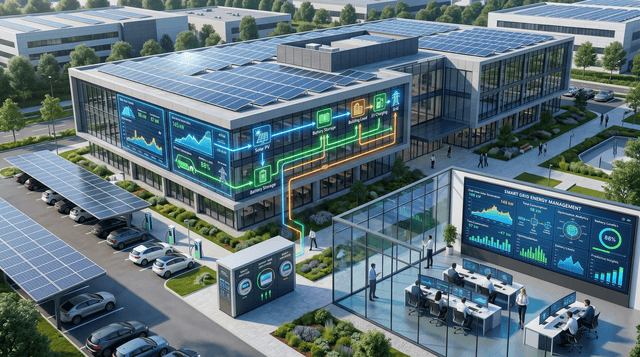
For businesses, smart grid implementation means the ability to monitor, control, and optimize their energy consumption in real-time, integrating various energy sources including solar, wind, battery storage, and traditional grid power. The intelligence layer, powered by AI algorithms, enables predictive load balancing, demand response optimization, and automated decision-making based on energy pricing, weather patterns, and operational needs.
Key Components of Business Smart Grid Systems
- Advanced Metering Infrastructure (AMI): Smart meters that provide real-time energy consumption data with 15-minute or even 5-minute intervals
- Energy Management Systems (EMS): Software platforms that aggregate and analyze energy data from multiple sources
- IoT Sensors: Networked devices that monitor energy usage across facilities, equipment, and processes
- Energy Storage Systems: Battery systems that store excess energy for later use or load balancing
- Renewable Energy Integration: Solar panels, wind turbines, and other distributed energy resources
- AI Analytics Engine: Machine learning algorithms that predict energy usage, identify optimization opportunities, and automate control decisions
AI-Powered Energy Management Strategies
Predictive Energy Analytics
AI algorithms can analyze historical energy consumption patterns, weather data, production schedules, and external factors to predict future energy needs with remarkable accuracy. Machine learning models can identify:
- Seasonal consumption patterns: How energy usage varies by time of day, day of week, and season
- Weather-dependent fluctuations: Impact of temperature, humidity, and weather events on energy demands
- Production correlation: Links between manufacturing output and energy consumption
- Anomaly detection: Unusual energy usage that may indicate equipment malfunction or operational inefficiencies
According to a McKinsey study, businesses using predictive energy analytics can achieve 15-25% reduction in energy costs through improved load forecasting and demand response optimization. The AI systems continuously learn and improve their predictions, becoming more accurate over time as they process more data.
Real-Time Optimization and Control
AI-powered smart grids enable real-time decision-making that optimizes energy consumption based on multiple factors:
- Dynamic pricing: Automatically shift energy-intensive processes to periods of lower electricity rates
- Load balancing: Distribute energy consumption across multiple facilities to minimize peak demand charges
- Equipment optimization: Adjust HVAC systems, lighting, and other energy-consuming equipment based on occupancy and operational needs
- Renewable energy integration: Prioritize usage of on-site renewable energy sources when available
A manufacturing plant using AI-driven energy optimization reduced its peak demand by 35% and shifted 40% of energy consumption to off-peak hours, resulting in annual savings of $470,000 on energy bills.
Demand Response Management
Demand response programs allow businesses to reduce or shift their electricity usage during peak periods in response to utility incentives or grid reliability concerns. AI enhances demand response capabilities through:
- Automated load shedding: Systems that automatically reduce non-critical energy consumption during grid emergencies
- Price optimization: Real-time analysis of electricity prices to determine optimal usage patterns
- Grid participation: Businesses that can provide demand reduction services to grid operators for compensation
The Department of Energy estimates that demand response programs could provide up to 20% of U.S. peak capacity needs, with AI-enhanced systems offering more precise and valuable grid support.
Implementation Strategies for Businesses
Phase 1: Assessment and Baseline Establishment
Before implementing smart grid solutions, businesses need to:
- Conduct energy audit: Identify major energy consumption areas and inefficiencies
- Establish baseline metrics: Measure current energy consumption, costs, and carbon footprint
- Set objectives: Define specific goals for energy reduction and cost savings
- Identify quick wins: Identify low-cost improvements that can provide immediate benefits
A comprehensive energy audit typically reveals opportunities for 10-30% energy savings through no-cost or low-cost measures, providing the foundation for more advanced smart grid investments.
Phase 2: Infrastructure Upgrade
Key infrastructure components that need to be upgraded include:
- Smart meters: Replace traditional meters with smart meters capable of real-time data collection
- Network connectivity: Ensure reliable, high-speed connectivity between energy assets and management systems
- Control systems: Install automated controls for HVAC, lighting, and major equipment
- Energy storage: Consider battery systems for load balancing and backup power
The average cost for smart meter installation is $50-200 per point, while comprehensive energy management systems typically cost $100,000-$500,000 for medium-sized businesses, with ROI periods of 2-5 years.
Phase 3: AI and Analytics Integration
The intelligence layer is what transforms basic energy monitoring into a sophisticated smart grid:
- Data integration: Connect multiple data sources including utility bills, meter readings, equipment sensors, and external factors
- Machine learning models: Develop predictive algorithms customized to the business's specific energy usage patterns
- Dashboard and visualization: Create intuitive interfaces for monitoring and decision-making
- Automated controls: Implement systems that can automatically adjust energy usage based on optimization rules
Businesses that implement comprehensive AI-powered energy management typically see 15-25% energy cost reductions within the first year of operation.
Phase 4: Continuous Improvement
Smart grid systems are not one-time implementations but ongoing processes:
- Model refinement: Continuously improve AI algorithms with new data and changing conditions
- Optimization updates: Adjust control parameters and optimization rules based on performance
- New technology integration: Incorporate emerging technologies like advanced batteries, new renewable sources, and grid-edge computing
- Stakeholder engagement: Involve employees, suppliers, and customers in energy optimization efforts
Industry-Specific Applications
Manufacturing
Manufacturing facilities are among the largest energy consumers, making them ideal candidates for smart grid implementation:
- Process optimization: AI can identify optimal production schedules that minimize energy consumption while maintaining output
- Equipment monitoring: Real-time monitoring of energy-intensive machinery to identify maintenance needs and optimize operation
- Waste heat recovery: Systems that capture and reuse waste heat from industrial processes
- Predictive maintenance: AI algorithms that predict equipment failure before it occurs, reducing energy waste from malfunctioning systems
A steel manufacturer implemented AI-powered smart grid technology and achieved 22% energy efficiency improvements, reducing annual energy costs by $1.2 million while maintaining production levels.
Commercial Buildings
Office buildings, retail spaces, and commercial real estate can significantly benefit from smart grid technology:
- HVAC optimization: AI-controlled systems that adjust heating, cooling, and ventilation based on occupancy, weather, and usage patterns
- Lighting control: Intelligent lighting systems that adjust based on natural light availability and occupancy
- Plug load management: Automated control of computers, monitors, and other office equipment
- Space utilization: Optimization of energy usage based on actual space occupancy rather than assumed patterns
A large office building implemented smart grid technology and reduced energy consumption by 18%, while improving occupant comfort and satisfaction through better environmental control.
Data Centers
Data centers are critical infrastructure with massive energy demands:
- Server optimization: AI systems that automatically adjust server loads based on processing needs and energy availability
- Cooling management: Intelligent cooling systems that optimize air flow and temperature based on real-time demands
- Power distribution: Automated systems that route power efficiently and provide backup during outages
- Renewable integration: Use of on-site solar power and battery storage to reduce grid dependence
A major cloud provider implemented AI-powered energy management in its data centers and achieved 40% improvement in energy efficiency, reducing costs by $15 million annually while improving service reliability.
Economic Benefits and ROI Analysis
Cost Reduction Potential
AI-powered smart grid systems deliver multiple economic benefits:
- Direct energy cost reduction: 15-35% reduction in electricity bills through optimization and demand response
- Demand charge reduction: 20-50% reduction in peak demand charges through load management
- Maintenance cost savings: 10-20% reduction in equipment maintenance through predictive monitoring
- Carbon cost avoidance: Reduction in carbon taxes and compliance costs through improved efficiency
A mid-sized manufacturer implementing smart grid technology with AI optimization achieved:
- 28% reduction in energy costs
- 42% reduction in peak demand charges
- 15% reduction in maintenance costs
- $680,000 annual savings with a 2.5-year payback period
Financial Incentives and Support
Businesses can access various financial incentives to offset implementation costs:
- Tax credits: Federal and state tax credits for energy efficiency investments (often 10-30% of costs)
- Utility rebates: Rebates from utility companies for smart meter installation and energy management systems
- Green financing: Low-interest loans and financing specifically for sustainability projects
- Performance contracts: Energy service companies that finance projects through guaranteed energy savings
The Inflation Reduction Act provides significant tax credits for energy efficiency investments, including up to 30% tax credits for smart grid technologies and 30% bonus depreciation for energy property.
Risk Mitigation Benefits
Beyond cost savings, smart grid systems provide important risk mitigation:
- Grid reliability: Reduced risk of power outages through better energy management and backup systems
- Price volatility: Protection against energy price spikes through load shifting and renewable integration
- Regulatory compliance: Reduced risk of penalties for energy efficiency mandates and carbon regulations
- Operational resilience: Improved ability to maintain operations during energy disruptions
A retail chain reported that their smart grid system prevented $2.3 million in potential losses during a regional power outage by providing backup power and enabling strategic load shedding.
Sustainability Impact and Environmental Benefits
Carbon Reduction
AI-powered smart grid systems significantly reduce carbon emissions:
- Energy efficiency: Reduced overall energy consumption means lower greenhouse gas emissions
- Renewable integration: Better utilization of solar, wind, and other clean energy sources
- Grid optimization: Reduced transmission losses and improved grid efficiency
- Demand response: Support for cleaner energy grids by reducing peak demand during carbon-intensive periods
According to the World Economic Forum, smart grid technologies could reduce global carbon emissions by 1.5-2 gigatons annually by 2030, equivalent to removing 300-400 million cars from the road.
Resource Conservation
Beyond carbon reduction, smart grids provide broader environmental benefits:
- Water conservation: Reduced water usage in power generation through improved efficiency
- Waste reduction: Lower material consumption through longer equipment life and reduced need for new generation capacity
- Habitat preservation: Reduced land use for new power plants through efficiency improvements
- Pollution reduction: Lower emissions of air pollutants including sulfur dioxide, nitrogen oxides, and particulate matter
A 2023 study by the Natural Resources Defense Council found that businesses implementing smart grid technologies achieved an average 35% reduction in their environmental footprint per unit of production.
Corporate Social Responsibility
Smart grid implementation enhances corporate sustainability credentials:
- ESG performance: Improved Environmental, Social, and Governance metrics
- Stakeholder trust: Enhanced reputation with customers, investors, and employees
- Brand differentiation: Competitive advantage through sustainability leadership
- Future-proofing: Positioning for increasingly stringent environmental regulations
A global consumer goods company reported that their smart grid implementation improved their ESG score by 15 points, directly contributing to improved investor relations and brand valuation.
Technical Implementation Considerations
Data Management and Security
Smart grid systems generate vast amounts of data that must be properly managed:
- Data privacy: Compliance with regulations including GDPR, CCPA, and industry-specific requirements
- Cybersecurity: Protection against cyber threats that could disrupt energy systems
- Data integration: Combining data from multiple sources while maintaining accuracy and reliability
- Scalability: Systems that can grow with the business and handle increasing data volumes
The Department of Energy reports that 70% of smart grid cyber incidents involve unauthorized access to data systems, highlighting the importance of robust cybersecurity measures.
Integration with Existing Systems
Successful implementation requires careful integration with existing infrastructure:
- Legacy systems: Integration with existing building management systems and industrial control systems
- Utility interfaces: Compatibility with utility smart meter systems and demand response programs
- Renewable integration: Seamless connection with solar, wind, and battery storage systems
- Enterprise systems: Connection with ERP, manufacturing execution systems, and other business platforms
Businesses often underestimate the complexity of system integration, with 60% of smart grid implementations experiencing delays due to integration challenges.
Vendor Selection and Partnership
Choosing the right technology partners is critical for success:
- Technology expertise: vendors with proven experience in smart grid and AI technologies
- Industry knowledge: partners who understand the specific energy challenges of your industry
- Support capabilities: vendors who can provide ongoing maintenance and optimization support
- Cost structure: transparent pricing models that align with expected ROI
A careful vendor evaluation process typically takes 3-6 months and can save businesses 20-30% in implementation costs while improving system performance.
Future Trends and Emerging Technologies
Artificial Intelligence Advancements
AI capabilities continue to evolve, bringing new opportunities for smart grid optimization:
- Deep learning: More sophisticated neural networks that can identify complex patterns in energy data
- Edge computing: AI processing at the edge of the grid for faster response times
- Digital twins: Virtual models of energy systems for testing optimization strategies
- Federated learning: AI models trained across multiple locations without sharing sensitive data
According to Gartner, by 2027, 70% of enterprises will use edge AI for real-time energy optimization, compared to 15% in 2024.
Emerging Grid Technologies
New technologies are expanding the capabilities of smart grids:
- Microgrids: Local energy systems that can operate independently from the main grid
- Vehicle-to-grid (V2G): Electric vehicles that can provide energy back to the grid
- Blockchain: Distributed ledger technology for energy trading and carbon credits
- Advanced storage: Next-generation battery technologies with improved performance and cost
The International Energy Agency projects that microgrids could provide 20% of global electricity by 2035, creating significant opportunities for AI-powered optimization.
Policy and Regulatory Evolution
Government policies continue to shape the smart grid landscape:
- Carbon pricing: Increasing costs for carbon emissions that favor energy efficiency
- Renewable mandates: Requirements for renewable energy usage and carbon reduction
- Grid modernization: Investments in transmission and distribution infrastructure
- Digital standards: Frameworks for data sharing and system interoperability
The Inflation Reduction Act allocates $369 billion for clean energy investments, including significant funding for smart grid technologies and energy efficiency.
Case Studies and Success Stories
Case Study 1: Manufacturing Company XYZ
Company: Mid-sized automotive parts manufacturer Challenge: Energy costs rising 15% annually, peak demand charges accounting for 40% of energy bills Solution: AI-powered smart grid implementation with predictive analytics and automated load control Results:
- 28% reduction in total energy costs
- 45% reduction in peak demand charges
- 350,000 kWh annual energy savings
- $680,000 annual savings with 2.5-year payback
- 20% improvement in carbon footprint per unit produced
Case Study 2: Retail Chain ABC
Company: 500-location retail chain with mixed facility types Challenge: Inconsistent energy performance across locations, difficulty managing peak demand Solution: Centralized AI energy management system with facility-specific optimization Results:
- 18% average reduction in energy consumption across all locations
- 32% reduction in peak demand charges
- Improved customer comfort and satisfaction
- $2.3 million savings during regional power outage event
- Enhanced sustainability credentials for brand reputation
Case Study 3: Data Center DEF
Company: Regional cloud services provider Challenge: High energy costs affecting competitiveness, pressure to improve sustainability metrics Solution: AI-powered smart grid with server optimization, cooling management, and renewable integration Results:
- 40% improvement in energy efficiency (PUE reduced from 1.6 to 1.36)
- $15 million annual energy cost reduction
- 25% increase in processing capacity per rack
- Improved service reliability with 99.99% uptime
- Enhanced ESG score leading to better investor relations
Implementation Roadmap and Best Practices
Step-by-Step Implementation Process
Assessment Phase (2-3 months)
- Energy audit and baseline establishment
- Stakeholder engagement and goal setting
- Vendor evaluation and technology selection
- Financial planning and incentive identification
Planning Phase (2-4 months)
- Detailed system design and architecture
- Integration planning with existing systems
- Change management strategy development
- Implementation timeline and resource allocation
Implementation Phase (6-12 months)
- Infrastructure upgrades and hardware installation
- Software deployment and system integration
- Testing and validation of all components
- User training and change management execution
Optimization Phase (Ongoing)
- AI model training and refinement
- Continuous performance monitoring
- System updates and technology refreshes
- Expansion to additional facilities or processes
Key Success Factors
Leadership Commitment: Strong executive support and dedicated resources are essential for successful implementation. Energy transformation initiatives typically require C-level sponsorship and cross-departmental coordination.
Data Quality: The effectiveness of AI-powered smart grids depends on high-quality, comprehensive data. Businesses should invest in data collection and management systems that provide accurate, timely information for optimization algorithms.
Change Management: Employee engagement and training are critical for realizing the full potential of smart grid systems. Organizations that invest in comprehensive change management programs achieve 40-50% higher implementation success rates.
Continuous Improvement: Smart grid systems require ongoing attention and optimization. Businesses that establish continuous improvement processes achieve 2-3 times greater ROI than those with one-time implementations.
Common Pitfalls to Avoid
- Underestimating Integration Complexity: Many businesses fail to account for the challenges of integrating smart grid systems with existing infrastructure
- Insufficient Data Strategy: Without proper data management, AI algorithms cannot deliver optimal results
- Neglecting Change Management: Technical success without organizational adoption leads to underwhelming results
- Ignoring Cybersecurity: Smart grids represent attractive targets for cyber attacks requiring robust security measures
- Short-Term Focus: Viewing smart grid implementation as a one-time project rather than an ongoing optimization process
Conclusion: The Path to Energy Intelligence
AI-powered smart grid technology represents one of the most significant opportunities for businesses to simultaneously reduce costs, improve sustainability, and enhance competitiveness. The convergence of AI, IoT, and energy management creates unprecedented potential for intelligent energy optimization.
The businesses that will thrive in the coming decades are those that recognize energy not as a simple utility expense but as a strategic asset that can be optimized through intelligent systems. By implementing AI-powered smart grid solutions, organizations can transform their energy management from a reactive cost center to a proactive competitive advantage.
The transition to energy intelligence requires investment, planning, and commitment, but the returns—both financial and environmental—are substantial. As energy markets continue to evolve and sustainability pressures intensify, smart grid implementation will move from competitive advantage to business necessity.
The question for businesses is not whether to implement AI-powered smart grid technology, but rather how quickly they can deploy these systems to maintain their competitive position in an increasingly energy-conscious world. The organizations that embrace this transformation today will be the leaders of tomorrow's sustainable business landscape.
About the Author
This article is part of IoTree Ltd's ongoing commitment to helping businesses leverage AI and IoT technologies for operational excellence and sustainability. IoTree provides comprehensive AI-powered energy management solutions that deliver measurable results for organizations across multiple industries.
Disclaimer: The information in this article is for educational purposes only. Businesses should consult with qualified energy and technology professionals before implementing smart grid solutions. Individual results may vary based on specific circumstances, facility characteristics, and implementation quality.